
Big Stone County Court Docket Searches
Every Big Stone County docket search starts in one place: Minnesota Court Records Online (MCRO). A case number works best. A citation number helps for a traffic matter. No number at hand? Search by name. Pick Big Stone as the county. Then tighten results with a filing-date range or the case-category control. A statewide search makes sense only when you don't know the county.
Name searching takes some care. MCRO wants an exact name, or a trailing wildcard after at least two characters. Sounds Like broadens results, but it won't combine with a wildcard. Start exact, stay in Big Stone County, then loosen one thing at a time. Whatever comes back is a doorway into a court record. It is not proof of how a case ended.
- Open MCRO and accept its public-access terms.
- Select Big Stone in the specific county list.
- Search by case number, citation number, or a careful name query.
- Open Case Details and the Register of Actions for the event history.
- Contact court administration for an official or certified copy.
MCRO Searches for Big Stone Cases
MCRO splits its tools into four routes. Case Search covers people, businesses, attorneys, case numbers, citation numbers, and attorney bar numbers. Document Search needs a case number you already hold. Hearing Search indexes upcoming settings. Judgment Search handles docketed money judgments and satisfactions, not the whole civil docket.
| MCRO route | Useful Big Stone search | What to remember |
|---|---|---|
| Case Search | Case number, citation, or party name | Select Big Stone to reduce statewide noise. |
| Document Search | Known case number | Only eligible public online documents appear. |
| Hearing Search | Name, case number, date, or officer | It is not the posted courthouse calendar. |
| Judgment Search | Judgment debtor and date | Use it for a docketed money judgment question. |
One catch worth knowing: a defendant-name search may skip pending criminal, traffic, and petty-misdemeanor matters that lack a conviction. So keep your notice or citation. Its case number is the reliable key, especially when a name query comes back empty.
Court Dockets: What They Show
Most people read a Big Stone County court docket through the Register of Actions. That record carries the case title. It lists the filings and proceedings in order, along with the activity the court has entered. It reaches wider than a calendar line. One line may mark a setting, a filing, an order, or a disposition. It still needs reading alongside the full case details and the access limits that apply.
| Case Number | The identifier used to retrieve a specific court file. |
|---|---|
| Parties | The people, businesses, or agencies named in the public case record. |
| Register of Actions | The running list of filed activity, proceedings, and court events. |
| Hearing Setting | A scheduled event, date, time, and listed hearing information. |
| Court and Officer | The court location and judicial officer shown for a setting. |
| Disposition | An event that must be read in the full record before drawing a conclusion. |
Big Stone Calendars and Registers
A calendar and a Register of Actions answer two different questions. The Big Stone public calendar lays out the hearings. The Register of Actions tells the case history. Each calendar entry can show party name, hearing location, date, time, judicial officer, hearing type, connection type, and case number. Labels like arraignment, pre-trial, sentencing, or conciliation hearing describe a procedural event only. None of them is a result.
For any filed Big Stone County case, let the court record explain the activity. Let the calendar confirm a set appearance. If the two disagree, local court administration settles it. And for same-day accuracy, the printed calendars beat everything else. You'll find them outside courtrooms and in public lobbies.
- Calendar
- A schedule of matters set to be heard or tried.
- Register of Actions
- The case record's running list of titles, filings, activities, and proceedings.
- Certified copy
- A court-authenticated copy supplied through the court's copy process.
Big Stone County Courts and Their Dockets
Big Stone County files its cases in one general-jurisdiction trial court. That court is Minnesota District Court, Big Stone County. Civil, family, probate, juvenile, criminal, and traffic matters all land there. A city, a sheriff, a prosecutor, or an agency may feed information into a case. None of that creates a separate searchable city docket. Questions about an individual file go to Big Stone County District Court administration.
| Court or record route | What it covers | Where to search |
|---|---|---|
| Minnesota District Court, Big Stone County | Filed county civil, family, probate, juvenile, criminal, and traffic cases | MCRO, courthouse terminal, or local court administration |
| Minnesota Court of Appeals | Appeals from trial-court matters | Its separate appellate record path |
| Federal court | Federal and bankruptcy matters, not county district cases | Federal court resources and PACER |
Big Stone's Eighth District Route
Minnesota's Eighth Judicial District has thirteen counties. Big Stone County is one of them. District administration coordinates court operations across those counties. Yet it never hears an individual Big Stone case. When you already know the county, select Big Stone in MCRO. That keeps your results from sprawling across the district or the state.
For the district's county structure, see the Minnesota Judicial Branch Eighth District page, which lists every county the Eighth covers.
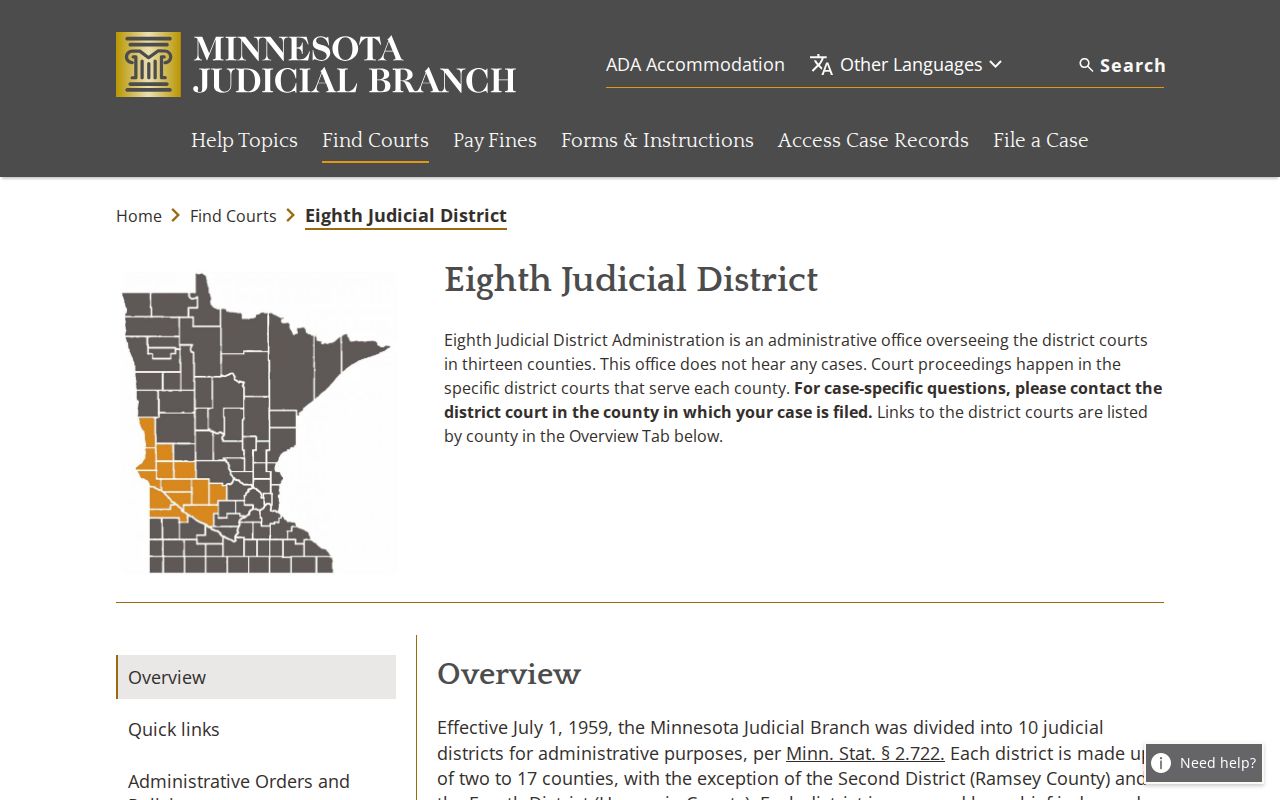
The district map is useful context for how the court system fits together. It won't replace a Big Stone County case search, though, or a call to the local court administrator about a particular file.
Court Dates and Settings in Big Stone County
The Big Stone weekly public calendar is a PDF listing courtroom hearings. It goes up at 7:00 a.m. on business days and gets updated hourly. It still won't list everything. Confidential cases and matters unavailable remotely may be left out, so a missing line doesn't mean a case was canceled or moved.
MCRO Hearing Search can find a hearing by name, case number, judicial officer, attorney, date, category, or county. For parties, the hearing notice controls appearance instructions. Minnesota runs Zoom and telephone conferences under its statewide framework, but a remote link or call-in method should come from the notice or the court, never from a guessed local room.
Big Stone County Calendar Checks
Pull the current public PDF close to the hearing date, then cross-check it with MCRO Hearing Search when you have a case number. The local calendar reads as a schedule; Hearing Search offers different filters. A hearing type adds context. It never replaces the case history or a current instruction from the court.
Unsure about a court date? Call the Big Stone County District Court Administrator. Courthouse printed calendars run ahead of any earlier online version. eCheck-In may be open for eligible adult criminal, traffic, and juvenile matters in most Minnesota counties, but it doesn't substitute for a hearing notice or a judicial direction.
Note: Calendars can shift after you check them, so the notice, the current court schedule, and local administration remain the safest sequence for confirming a Big Stone County court date.
Docket Access Under Minnesota Law
Minnesota's Rules of Public Access to Records of the Judicial Branch set the rules for Big Stone County court records. Rule 8 gives the public the right to inspect and copy accessible original records. That happens at their normal place, during regular hours. The rule also allows a controlled format instead. That applies when direct access could expose nonpublic information, create an improper remote or bulk-access risk, or prove impractical.
Key Rules:
Rule 8 explains inspection, copies, remote access, terminals, and records access limits.
Minn. Stat. § 13.90 separates judicial records from ordinary county Chapter 13 data practices.
Minn. Stat. Chapter 609A provides the statutory framework for expungement and sealing.
A record can be public at a courthouse terminal yet unavailable through remote MCRO. Restricted categories include certain domestic-abuse and harassment matters, CHIPS cases, and some juvenile matters. Protected addresses fall in too, as do pending criminal, traffic, and petty-misdemeanor cases reached through a defendant-name search.
Big Stone MCRO and Courthouse Access
Remote MCRO is convenient, but it is not the official court record. It also cannot certify a result. Courthouse public terminals, plus the State Law Library, show a broader set of public material. Need official or certified copies? Court administration is the route. The same goes for locally stored paper, a calendar question, or a record needing an access decision. The MCRO overview describes the search system and where its access stops.
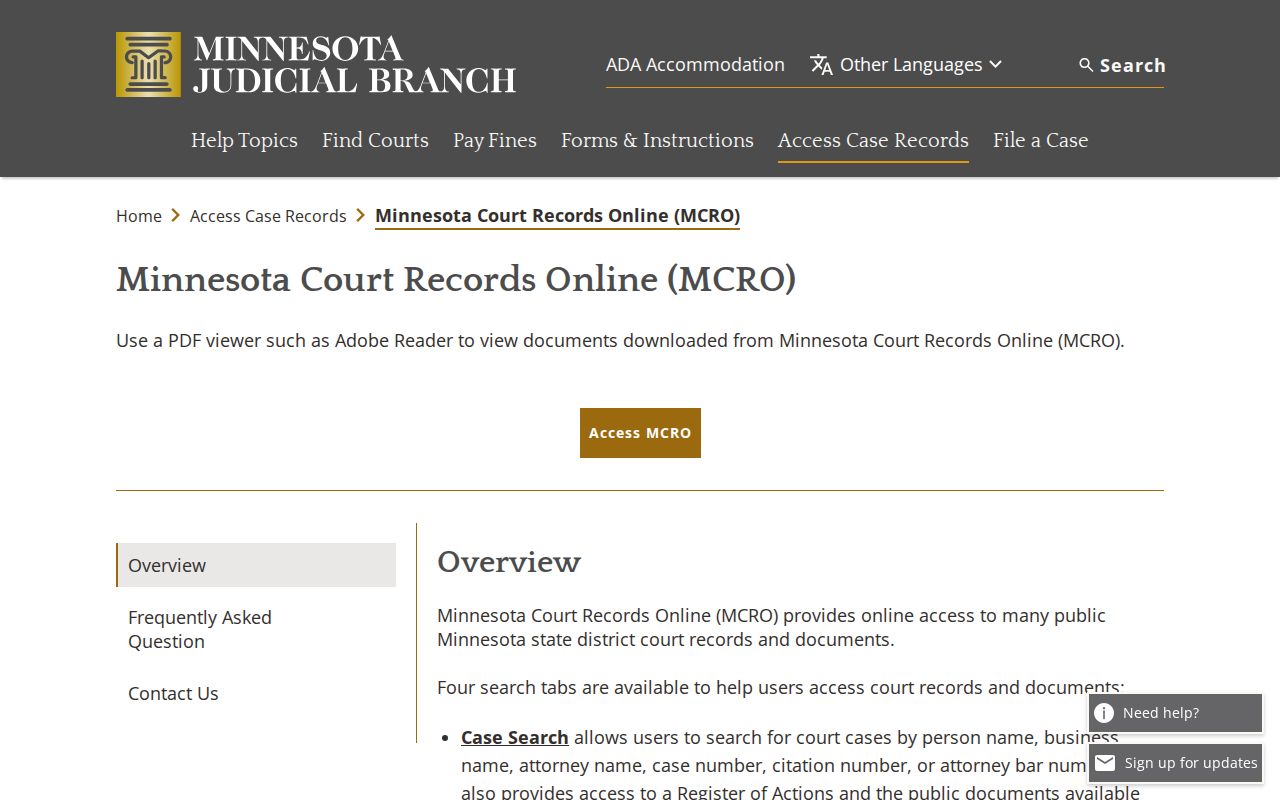
A missing remote result is a signal, not a verdict. Try a case number, a courthouse terminal, or local court administration. It does not mean no case was filed.
How the Clerk Keeps Docket Records
Big Stone County keeps its docket records with the District Court Administrator rather than a separate county clerk system. Rachel Schmidt is listed as Court Administrator. Court administration can explain copy and access procedures. Staff cannot give legal advice, though. When you request a Big Stone County record, include the case number if known, the specific document, the copy type, and how you want it delivered.
Big Stone County District Court Administration
20 S.E. Second Street
Ortonville, MN 56278
(320) 849-7005
Monday through Friday, 8:00 a.m. to 4:30 p.m.
Plain, certified, and exemplified copies get different treatment from the court. Most routine copy requests are described as same-day unless a file sits in off-site storage. Minnesota eFile and eServe can handle particular filings. An e-filed document stays part of the court file after acceptance. The county departments directory helps with county offices. A judicial case-file request still goes through the court's Rule 8 channels. It does not go automatically to a county administrative-data request.
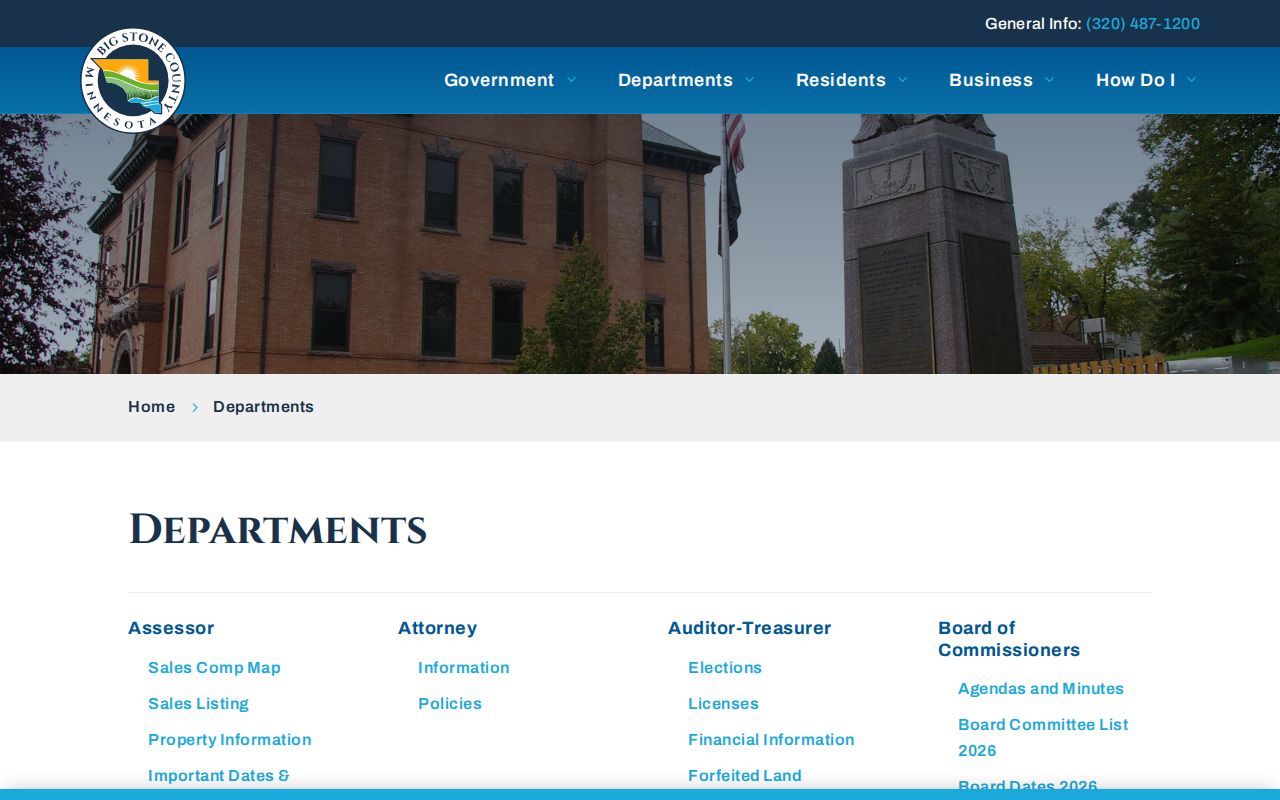
County government information and judicial case records sit with different offices. Identify the record type first. That keeps a court-file search from landing at the wrong desk.
Big Stone Courthouse Record History
Ortonville became the county seat during the county's 1874 organization work. The earlier courthouse burned in 1885. A temporary store and then a frame courthouse filled the gap before the present building. That courthouse went up in 1902, built of light tan brick and Ortonville granite. Fremont D. Orff designed it, and D.H. Olsen built it for $29,999. The history explains why the courthouse remains a meaningful local access point, even with MCRO offering a statewide online layer. It changes nothing about the current Rule 8 process, access restrictions, or copy requirements. For county-seat history, see the Big Stone County organization history.
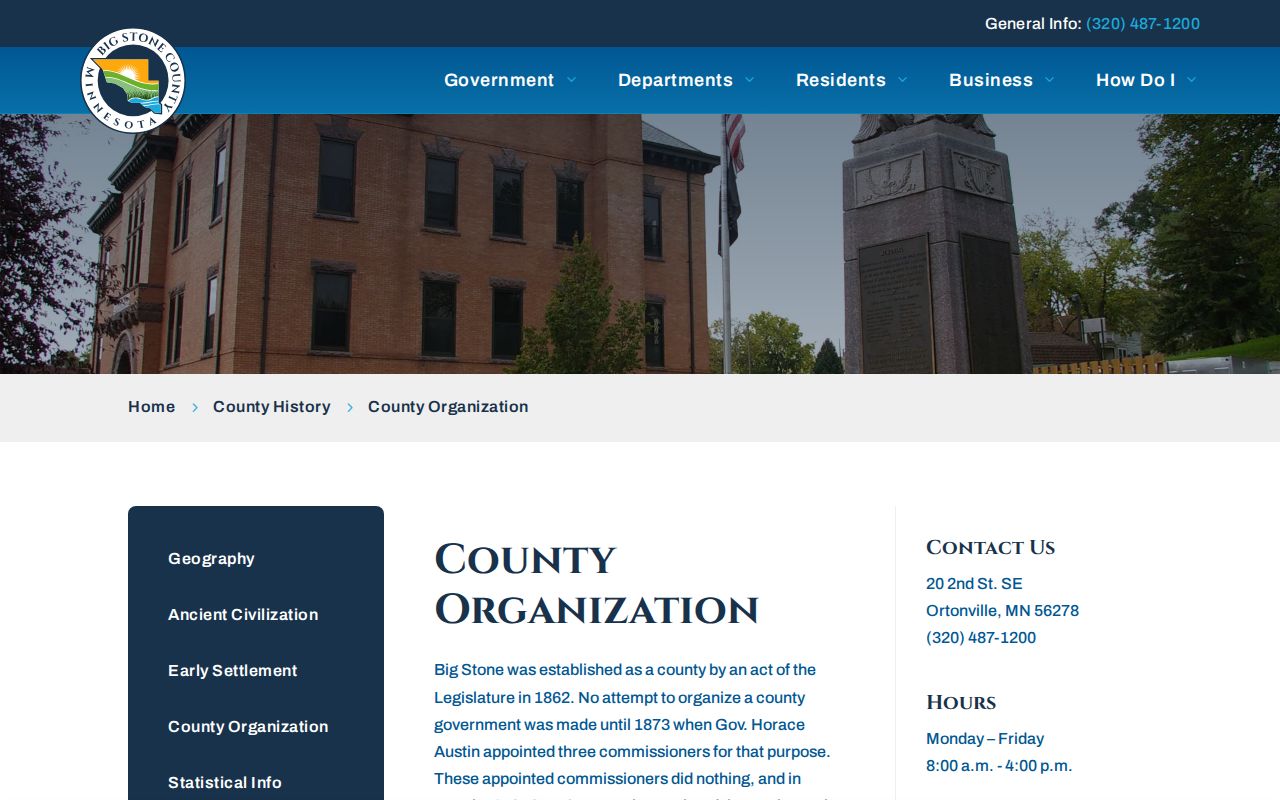
The historical county source places the courthouse in Ortonville. Current case and copy questions still go to Big Stone County District Court administration.
Four Cities in the Court Map
The 2020 Census table lists four incorporated cities in Big Stone County. They are Ortonville, Graceville, Clinton, and Beardsley. Their populations are 2,021, 529, 386, and 216 respectively. The county's broader community list includes other places. But only these four carry city court-record pages. For a filed case from any of them, MCRO and Big Stone County District Court are the common route. City contacts can still help with city administration or local ordinance routing. They are no substitute for the district court administrator when a filed court case is the subject.
City-by-City Court Dockets in Big Stone County
Each city record page keeps local context clear. Filed matters all point to the countywide district-court system instead. None of these four cities runs its own official municipal-court docket portal. Ortonville is the county seat and courthouse location. Graceville and Clinton offer city-government contacts for administrative questions. Beardsley posts no separate official city site or municipal portal.
Ortonville Court Records
2020 population 2,021. The Big Stone courthouse is in Ortonville; filed cases route through MCRO and district court administration.
Graceville Court Records
2020 population 529. The city clerk handles city administration; filed court records route through the district court.
Clinton Court Records
2020 population 386. City Hall is a civic contact; MCRO and district court administration handle court files.
Beardsley Court Records
2020 population 216. Use the county court route; no separate official municipal portal was located.
Big Stone County Record Checkpoints
A good court-record search moves through checkpoints rather than one result. Start with the county filter and the strongest identifier you have. Then confirm what the record actually is. Is it case history, a calendar setting, a public document, or a judgment entry? Decide whether remote MCRO access is enough. A courthouse terminal shows more public material. Court administration handles official and certified copies. Big Stone County's one-district-court structure keeps routing clear across Ortonville, Graceville, Clinton, and Beardsley. The city name gives local context. The court file itself is maintained through Minnesota District Court, Big Stone County. This approach also separates judicial records from county administrative data. That kind of data follows a different public-record process.
Big Stone County Court Access Paths
A Big Stone County court record can be reached through three public layers. MCRO gives remote access to many public cases. It shows hearings, judgments, and documents from home. A public-access terminal sits at a Minnesota courthouse or at the State Law Library. It opens a wider set of public material than any home search. For the rest, local court administration is the office to call. It issues certified copies. It holds locally stored paper, answers calendar questions, and makes access decisions no online search can make.
Match the channel to what you already know. A case number works in Case Search and Document Search. A citation number will pull up a traffic matter. Hearing Search helps when you have a date. The posted PDF and the printed courthouse calendar remain the local schedule checks. Judgment Search fits a judgment question. An authenticated document request goes straight to court administration. Each channel answers one part of a Big Stone County record question.
Rule 8 explains why these layers differ. A remote format can be limited for several reasons. Direct access might disclose nonpublic information. It could enable improper remote or bulk access, create a security concern, or prove impractical. So a court terminal or a staff-assisted request still matters. Even a public case search does not cover everything.
A copy request in Big Stone County follows a simple order. Locate the file first. Then identify the exact document. Tell court administration whether you need a plain or a certified copy. The online search, the public terminal, and the court counter each docket channel work together. They do not compete. No single one opens every record. Each protects the line between public information, a restricted court file, and a court-authenticated copy.
Map and Directions to the Big Stone County Courthouse
Big Stone County District Court files for civil, family, probate, juvenile, criminal, and traffic matters are kept at the Big Stone County Courthouse, 20 S.E. Second Street in Ortonville, the county's only district-court location and its seat since 1874. The 1902 courthouse building has a free public parking lot behind it.
Big Stone County Courthouse
20 S.E. Second Street
Ortonville, MN 56278
(320) 849-7005
Monday through Friday, 8:00 a.m. to 4:30 p.m.
Confirm closures and holiday hours with court administration before a trip from Graceville, Clinton, or Beardsley, since Ortonville sits at the western edge of the county on the South Dakota line and a wasted drive costs more time there than in a more central county seat.